GI Oncology Weekly The GI trials that shape practice.
Issue No. 07 August 26 – September 1, 2026
5 Readouts
2 Act on now
~10 min Clinical scan
This week · 5 readouts

The Verdicts

Every trial that matters this week, distilled to a single call — act on it, watch it, or keep it on the radar.
Practice-shaping Pancreas · previously treated metastatic adenocarcinoma

Daraxonrasib (RASONQUE) — FDA approval

The single most consequential thing to happen in pancreatic cancer in years. Daraxonrasib is approved for metastatic pancreatic adenocarcinoma after at least one prior systemic therapy, or for patients who cannot take multiagent chemotherapy — and it is the first RAS(ON) multi-selective inhibitor approved in any solid tumour. A median overall survival of 13.2 versus 6.7 months against physician's-choice chemotherapy, hazard ratio 0.40, is not an incremental number in this disease. Two things belong in the same breath. The comparator is second-line chemotherapy, which is a low bar by design and by necessity. And the label's warning list — dermatologic and soft-tissue toxicity, stomatitis, diarrhoea, GI perforation, ILD — is a real management burden for a drug patients may stay on for many months. Plan for the toxicity before the first prescription, not after it.
Go deeper
On August 26 the FDA approved daraxonrasib for adults with metastatic pancreatic adenocarcinoma who have received at least one prior systemic therapy, or who are not candidates for multiagent chemotherapy. This is the first approval of a RAS(ON) multi-selective inhibitor in any solid tumor, and it lands in the disease where RAS has been the defining, undruggable lesion for four decades. Efficacy came from RASolute 302 (NCT06625320), which randomized 500 patients 1:1 to daraxonrasib or physician's-choice chemotherapy. In the overall population median OS was 13.2 months (95% CI 10.0–NE) versus 6.7 months (95% CI 5.8–8.0), HR 0.40 (95% CI 0.30–0.53), p<0.0001; median PFS was 7.2 versus 3.6 months, HR 0.49 (95% CI 0.38–0.64), p<0.0001; and ORR was 30% versus 11%, p<0.0001. Benefit held in both the RAS G12-mutant population and the overall population. The dose is 300 mg orally once daily. Labeled warnings include dermatologic and soft-tissue toxicity, stomatitis, diarrhea, GI perforation, and ILD/pneumonitis — a real management burden for a drug patients may stay on for many months. Reviewed under Project Orbis with Health Canada, with EMA and PMDA as observers, via the Real-Time Oncology Review pilot. Full daily entry →
Survival over time · schematic — OS*
0501000612months
DaraxonrasibPhysician's-choice chemotherapy
· Median OS 13.2 mo (95% CI 10.0–NE) vs 6.7 mo (5.8–8.0), HR 0.40 (95% CI 0.30–0.53), p<0.0001· Median PFS 7.2 vs 3.6 mo, HR 0.49 (0.38–0.64), p<0.0001· ORR 30% vs 11%, p<0.0001· RASolute 302 (NCT06625320): 500 patients randomised 1:1 vs physician's-choice chemotherapy· Benefit held in both the RAS G12-mutant and the overall population· Dose 300 mg orally once daily
HR 0.4 ↓ 60% risk of death 95% CI 0.30–0.53 · Δ +6.5 mo median
Practice-shaping Gastroesophageal · first-line HER2-positive advanced disease

Zanidatamab + tislelizumab — FDA approval

The first-line standard in HER2-positive gastroesophageal adenocarcinoma has changed, and the interesting part is the fine print. Two regimens were approved on the same day and they are deliberately not interchangeable: the triplet — zanidatamab plus tislelizumab plus chemotherapy — is approved across IHC 3+ and IHC 2+/ISH+ with no PD-L1 requirement, while the immunotherapy-free doublet is restricted to IHC 3+. That restriction is not arbitrary. The doublet improved progression-free survival but its interim overall survival was not significant, and the effect concentrated in IHC 3+ tumours. Two companion diagnostics were approved alongside it. The practical consequence: HER2 scoring no longer just establishes eligibility, it selects which regimen your patient can have.
· Triplet vs trastuzumab + chemotherapy — median OS 26.4 mo (95% CI 21.5–30.3) vs 19.2 mo (16.8–21.8), HR 0.72 (0.57–0.90), p=0.0043· Median PFS 12.4 mo (9.8–18.5) vs 8.1 mo (7.0–8.9), HR 0.63 (0.51–0.78), p<0.0001· Zanidatamab + chemotherapy doublet: PFS improved, interim OS not significant; effect concentrated in IHC 3+ (median PFS 14.2 vs 7.6 mo, HR 0.55, 0.43–0.69)· HERIZON-GEA-01 (NCT05152147), three-arm 1:1:1, dual primary endpoints BICR-PFS and OS· Boxed warning for diarrhoea and embryo-fetal toxicity
HR 0.72 ↓ 28% risk of death 95% CI 0.57–0.90 · Δ +7.2 mo median
Survival over time · schematic — OS*
05010001224months
Zanidatamab + tislelizumab + chemoTrastuzumab + chemo
Go deeper
On August 25, 2026 the FDA approved two zanidatamab-hrii (Ziihera, Jazz Pharmaceuticals) regimens for previously untreated, unresectable locally advanced or metastatic HER2-positive gastric, gastroesophageal junction, or esophageal adenocarcinoma — and the two indications are deliberately not the same. The triplet, zanidatamab plus tislelizumab-jsgr (Tevimbra) plus fluoropyrimidine- and platinum-containing chemotherapy, is approved across HER2 IHC 3+ and IHC 2+/ISH+ disease with no PD-L1 requirement; the chemotherapy doublet, zanidatamab plus fluoropyrimidine/platinum without immunotherapy, is restricted to IHC 3+. In HERIZON-GEA-01 (NCT05152147), a three-arm 1:1:1 global trial against trastuzumab plus chemotherapy with dual primary endpoints of BICR-assessed PFS and OS, the triplet improved median OS to 26.4 months (95% CI 21.5–30.3) versus 19.2 months (16.8–21.8), HR 0.72 (0.57–0.90), p=0.0043, and median PFS to 12.4 months (9.8–18.5) versus 8.1 months (7.0–8.9), HR 0.63 (0.51–0.78), p<0.0001. The zanidatamab-plus-chemotherapy arm improved PFS but its interim OS was not statistically significant, and exploratory analysis attributed the effect primarily to IHC 3+ tumours, where median PFS was 14.2 versus 7.6 months (HR 0.55, 0.43–0.69) — which is precisely where the label draws its line. Zanidatamab carries a boxed warning for diarrhoea and embryo-fetal toxicity plus warnings for left ventricular dysfunction and infusion-related reactions, and two Roche/Ventana companion diagnostics (PATHWAY anti-HER-2/neu 4B5 and VENTANA HER2 Dual ISH) were approved the same day, so HER2 scoring now determines which of the two regimens a patient is eligible for rather than simply establishing HER2 positivity. Full daily entry →
Worth watching Liver · untreated, TACE-eligible hepatocellular carcinoma

TALENTACE

A genuine first that stops short of changing practice, and the gap between those two statements is the whole story. TALENTACE is the first Phase 3 to add atezolizumab plus bevacizumab to on-demand chemoembolisation and meet its primary endpoint: TACE progression-free survival 11.30 versus 7.03 months. But TACE-PFS is a composite of local progression and the need for re-treatment — it measures how long the embolisation strategy holds, not how long the patient lives. Overall survival at the first interim analysis is flat and immature: 34.53 versus 35.38 months, hazard ratio 0.96. That is not a negative survival result, it is an absent one. Worth watching precisely because the endpoint that moved is not the endpoint that decides.
· TACE progression-free survival 11.30 vs 7.03 mo (HR 0.71, 95% CI 0.55–0.92, p=0.0089)· Overall survival immature, no separation: 34.53 vs 35.38 mo (HR 0.96, 99.62% CI 0.58–1.58)· n=342 randomised, multicentre open-label Phase 3
HR 0.71 ↓ 29% risk of progression 95% CI 0.55–0.92 · Δ +4.3 mo median
Survival over time · schematic — TACE-PFS*
0501000612months
TACE + atezolizumab–bevacizumabTACE alone
Go deeper
TALENTACE randomised 342 patients with untreated, TACE-eligible hepatocellular carcinoma to on-demand transarterial chemoembolisation plus atezolizumab and bevacizumab, or to TACE alone. The trial met its primary endpoint: median TACE progression-free survival was 11.30 months with the combination versus 7.03 months with TACE alone (HR 0.71, 95% CI 0.55-0.92, p=0.0089). Overall survival remains immature at the first interim analysis and shows no separation so far — 34.53 versus 35.38 months (HR 0.96, 99.62% CI 0.58-1.58). This is the first positive Phase 3 read on adding checkpoint blockade plus anti-VEGF to embolisation on that trial's own primary endpoint, but TACE-PFS is a composite of local progression and re-treatment need, not survival. The practice question stays open until the OS curves mature. Full daily entry →
Worth watching Colorectal · first-line RAS/BRAF wild-type metastatic disease

DEEPER

The final analysis of DEEPER reinforces sidedness as a first-line selection variable without settling it, and the honest reading requires holding two facts at once. In the overall per-protocol set there was no difference between cetuximab and bevacizumab on either progression-free or overall survival. The entire signal sits in the left-sided RAS/BRAF wild-type subgroup, where cetuximab produced a median overall survival of 50.2 versus 40.2 months. A ten-month median gap is not a small effect and it points the same way as the rest of the sidedness literature. But it is a subgroup of a randomised Phase II whose overall comparison was flat, and the overall survival confidence interval crosses 1. Use it to support a decision you were already making on sidedness; do not use it to claim the question is closed.
· Overall per-protocol set: no difference in PFS or OS between cetuximab and bevacizumab· Left-sided RAS/BRAF wild-type — median PFS 14.8 vs 11.9 mo (HR 0.71, 95% CI 0.52–0.97, p=0.029)· median OS 50.2 vs 40.2 mo (HR 0.74, 95% CI 0.53–1.05)· Randomised Phase II, modified-FOLFOXIRI backbone in both arms
HR 0.74 No significant difference 95% CI 0.53–1.05 · Δ +10 mo median · p=0.029
Survival over time · schematic — OS*
050100012243648months
mFOLFOXIRI + cetuximabmFOLFOXIRI + bevacizumab
Go deeper
The final analysis of the randomised Phase II DEEPER trial compared modified FOLFOXIRI plus cetuximab against modified FOLFOXIRI plus bevacizumab in first-line RAS/BRAF wild-type metastatic colorectal cancer. In the overall per-protocol set there was no difference in either progression-free or overall survival between the two biologics. The signal is confined to the left-sided RAS/BRAF wild-type subgroup, where cetuximab produced a median PFS of 14.8 versus 11.9 months (HR 0.71, 95% CI 0.52-0.97, p=0.029) and a median OS of 50.2 versus 40.2 months (HR 0.74, 95% CI 0.53-1.05). A ten-month median OS gap is not a small effect, but it sits in a subgroup of a Phase II trial whose overall comparison was flat, and the OS confidence interval crosses 1. This reinforces sidedness as a first-line selection variable rather than settling it. Full daily entry →
On the radar Colorectal · adenoma recurrence after endoscopic resection

J-CAP-C

The cleanest teaching case of the week. J-CAP-C randomised 577 patients after endoscopic resection to two years of submicron-powdered curcumin or placebo, and the primary endpoint — adenoma detection rate at two years — was flatly negative, relative risk 0.98. The prespecified secondary endpoints were positive, and consistently so: fewer adenomas ≥6 mm, fewer of them per patient, smaller median size. That pattern is worth taking seriously as a hypothesis, because it is internally coherent rather than a lone significant p-value. It is not evidence that curcumin prevents adenomas, and the trial should not be cited that way. What it earns is a properly powered trial with adenoma size as the primary endpoint.
· Primary endpoint NOT met — adenoma detection rate at 2 years RR 0.98 (95% CI 0.82–1.16)· Prespecified secondary: adenomas ≥6 mm RR 0.56 (95% CI 0.33–0.95), P=0.04· fewer such adenomas per patient (P=0.03)· smaller median adenoma size (P=0.003)· n=577 (curcumin 287, placebo 290), Theracurmin 180 mg twice daily for 2 years· Registered jRCTs061180079
Go deeper
J-CAP-C randomized 577 patients (curcumin 287, placebo 290) after endoscopic resection of colorectal neoplasia to submicron-powdered curcumin (Theracurmin) 180 mg twice daily or identical placebo for two years. The primary endpoint was not met: the adenoma detection rate at two years was essentially unchanged, RR 0.98 (95% CI 0.82–1.16). Prespecified secondary analyses were positive — adenomas ≥6 mm were significantly less frequent, RR 0.56 (95% CI 0.33–0.95), P=0.04, with fewer such adenomas per patient (P=0.03) and a smaller median adenoma size (P=0.003). Exploratory analyses suggested a larger effect in patients with a higher baseline adenoma burden and in men. Registered as jRCTs061180079. Full daily entry →
* Survival curves are illustrative — modeled from each trial’s reported median and hazard ratio (assuming exponential survival), not the published Kaplan–Meier curves.
Regulatory · what to watch

Recent Regulatory Approvals

Regulatory milestones from the week, with the practice-relevant detail.
FDA APPROVAL

Daraxonrasib (RASONQUE) — metastatic pancreatic adenocarcinoma, after at least one prior systemic therapy

Approved August 26. The first RAS(ON) multi-selective inhibitor approved in any solid tumour, and the first new mechanism to reach metastatic pancreatic cancer in a generation. Also indicated for patients who are not candidates for multiagent chemotherapy. Evidence base RASolute 302: median overall survival 13.2 versus 6.7 months against physician's-choice chemotherapy, HR 0.40 (95% CI 0.30–0.53), p<0.0001. Dose 300 mg orally once daily. Reviewed under Project Orbis with Health Canada via the Real-Time Oncology Review pilot. Full breakdown in the August 27 daily edition.

FDA APPROVAL

Zanidatamab-hrii (Ziihera), with and without tislelizumab-jsgr (Tevimbra), plus chemotherapy — first-line HER2-positive gastroesophageal adenocarcinoma

Approved August 25, one day before daraxonrasib. Two regimens with deliberately different eligibility: the triplet with tislelizumab covers IHC 3+ and IHC 2+/ISH+ with no PD-L1 requirement, while the immunotherapy-free doublet is restricted to IHC 3+. In HERIZON-GEA-01 the triplet raised median overall survival to 26.4 versus 19.2 months (HR 0.72, 0.57–0.90, p=0.0043). Two Roche/Ventana companion diagnostics were approved the same day, so HER2 scoring now selects the regimen rather than merely establishing eligibility. Full breakdown in the August 26 daily edition.

Figures

Daraxonrasib: where the ESMO guideline and the FDA label diverge
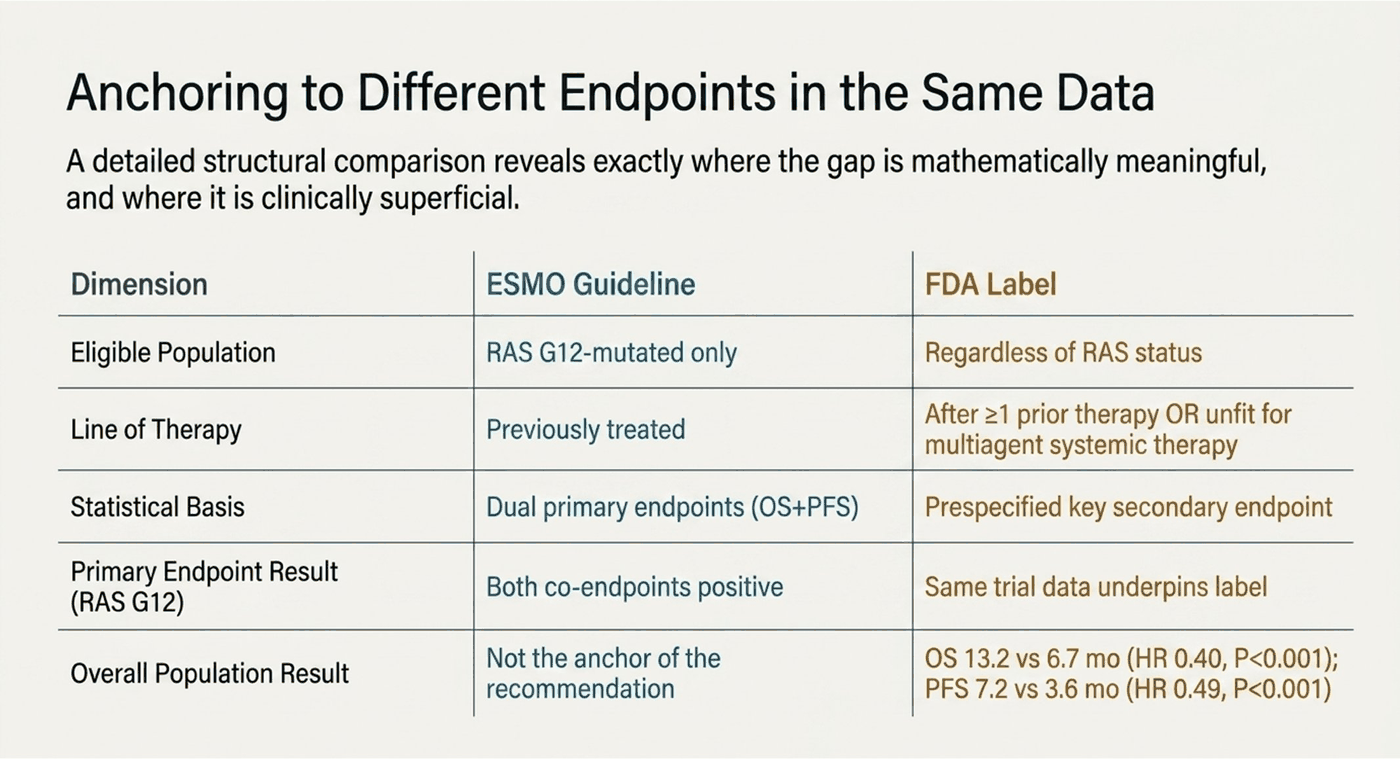
Two readings of the same RASolute 302 dataset. The recommendation and the label do not describe the same patient — and the gap matters most at the two ends of the fitness spectrum.
Comparison table, Anchoring to Different Endpoints in the Same Data, contrasting the ESMO guideline with the FDA label for daraxonrasib across five dimensions. Eligible population: ESMO, RAS G12-mutated only; FDA, regardless of RAS status. Line of therapy: ESMO, previously treated; FDA, after at least one prior therapy or unfit for multiagent systemic therapy. Statistical basis: ESMO, dual primary endpoints of overall survival and progression-free survival; FDA, prespecified key secondary endpoint. Primary endpoint result in RAS G12: ESMO, both co-endpoints positive; FDA, the same trial data underpins the label. Overall population result: ESMO, not the anchor of the recommendation; FDA, overall survival 13.2 versus 6.7 months, hazard ratio 0.40, P less than 0.001, and progression-free survival 7.2 versus 3.6 months, hazard ratio 0.49, P less than 0.001.
Same trial, two anchors. ESMO ties its recommendation to the RAS G12-mutated population and the dual primary endpoints; the FDA label rests on the same RASolute 302 data but carries no RAS restriction. The overall-population figures shown here are the ones reported in the August 27 daily edition.
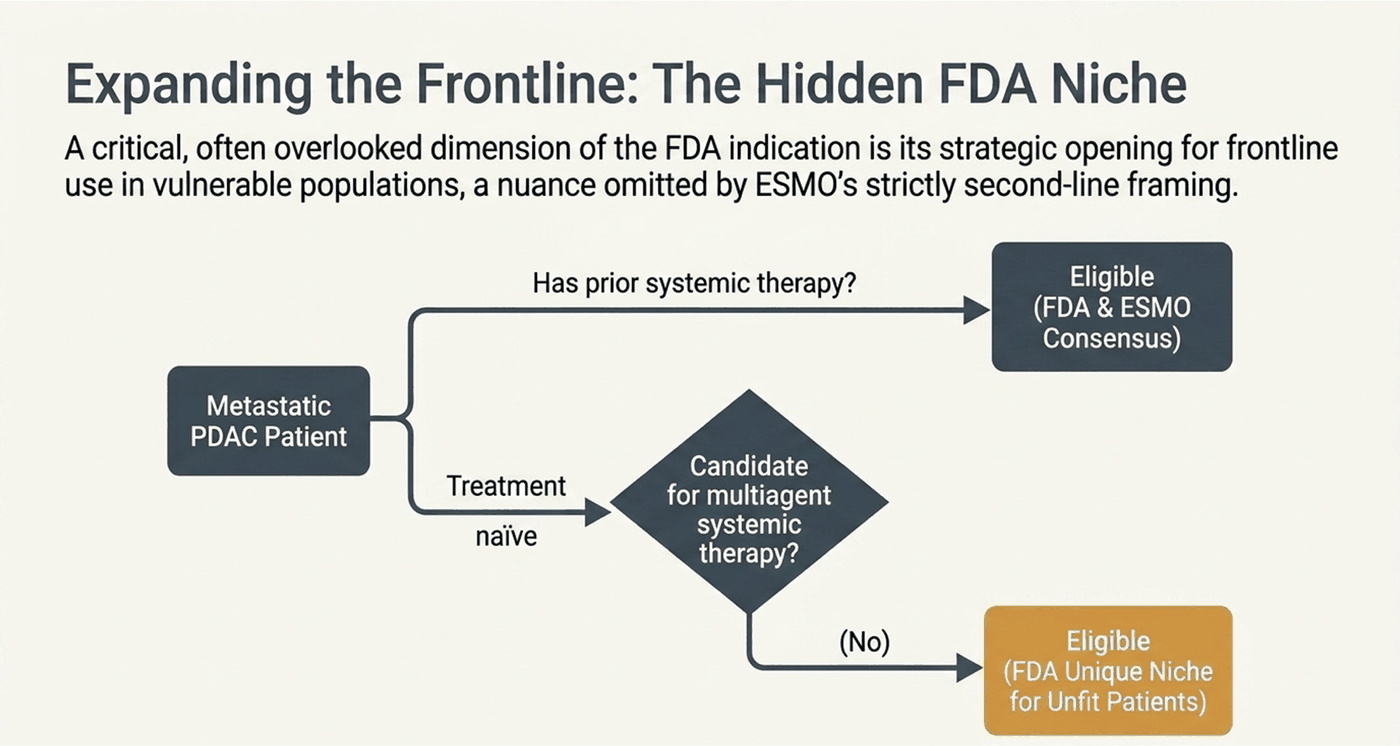
Flow chart, Expanding the Frontline: The Hidden FDA Niche. A patient with metastatic pancreatic ductal adenocarcinoma who has had prior systemic therapy is eligible under both the FDA label and ESMO consensus. A treatment-naive patient reaches a decision point: is the patient a candidate for multiagent systemic therapy? If no, the patient is eligible under a niche unique to the FDA label, covering unfit patients.
The consequence in clinic. The FDA indication also reaches treatment-naive patients who are not candidates for multiagent chemotherapy — a first-line opening for unfit patients that a strictly second-line framing does not address.
GI Oncology Weekly · curated by Dr. Allan Pereira, Moffitt Cancer Center. Educational summaries for practising oncologists — not medical advice; verify against primary sources before acting.
All weekly issues